Terrore e Miseria del III Reich
by Bertolt Brecht, translated by Federico Federici and with devised material by the company / 2023, Sala Teatro, Civica Scuola di Teatro Paolo Grassi, Milan / Directed by Ben Naylor with Silvia D’Anastasio / Assistant Director Emma Bolcato / Raps adapted and arranged from Brecht’s introductory verses by Mirko “Kiave” Filice / Sound and composition by Andrea Centonza / Lighting by Paolo Latini / Violence and intimacy by Bethan Clark / Movement direction by Davide Montagna / Scenography and stage management by Jiawen Chen, Martina Criconia, Camilla Garuglieri, Camilla Longoni, Francesca Mammana / Costume design and make-up by Beatrice Alberti, Sara Castrogiovanni, Valentina Corradini, Laura Mariani, Linda Valsecchi / Lighting tech by Simona Ornaghi, Luigi Chiaromonte / Projection tech by Dario Menichino / Wardrobe supervision by Nunzia Lazzaro, Fabiola Soldano / Scenographic management by Davide Petullá / Production management by Lorenzo Vannacci / Photography by Masiar Pasquali


Nel mezzo del cammin de nostra vita …
It astonishes even me to record that at the beginning of my 46th year, I had never set foot in Italy. In the spring of 2023 however, I was offered an extraordinary opportunity to correct this lacuna vitae and pop my Italian cilegia by directing a final-year production at the prestigious Paolo Grassi theatre school in Milan – perhaps not the first city that comes to mind for a first fling with Bella Italia; but a place I came quickly to love. Unaware that it would be a vehicle for one of my most personal artistic explorations yet, I chose to direct a play which had been on my radar since 2017, Brecht’s Fear and Misery of the Third Reich. Or rather, since it was to be performed in Italian – a language I do not speak – Terrore e Miseria del Terzo Reich.
In a sense this project was a culmination of my interest in recent years, indulged over several projects, in the theatrical translation of classic plays: of Shakespeare into other languages, and of foreign-language classics into English. In this instance, it was the staging of a collaborative adaptation from two parallel translations – English, in my case, and Italian, for the actors – of the German source text, Furcht und Elend des Dritten Reiches. (This would be my first full production of a play in a language other than English; when rehearsals began my understanding of Italian was limited to the gleanings available as a result of years of schoolboy Latin, a few popular phrases and a short and mostly fruitless frenzy of Duolingo.)
The reasons the play had nudged onto my bucket list had nothing to do with the translation question, nor indeed for reasons of personal proximity to the play’s theme – which did not particularly occur to me until the process was well underway. Rather the play, which Brecht wrote as he headed into exile from Nazi Germany in 1938, fascinated me as a picture of a society newly in the grips of totalitarian dictatorship; it was in the wake of the US elections of 2016 that I first started thinking about staging it. That fascination is intensified by the fact that a contemporary audience – unlike Brecht’s intended audience when he wrote the play – knows exactly how the story of Nazi Germany will turn out. A major play about perhaps the most shocking moment of the 20thcentury which knows less about that moment than does its 21st century audience.
The approach I had always wished to take with the play was to adapt it into a contemporary setting (though I changed my mind about the necessary dramaturgical principles by which this would be accomplished). Due to the restrictions of the Brecht estate in the UK (and despite the fact that this play really doesn’t qualify as canonical in the way Brecht’s writer-director work is held to be) this was a task I was unable to undertake at Central. In the more creative (or permissive) adaptational environment of Milan’s most famous drama school, I was able to pull this too-period piece into the present day.
The context of Italy in 2023 accomplished the first necessary recontextualization: the election of Giorgia Meloni’s far-right government in October 2022, and its immediate crackdown on LGBTQ+ rights in Italy, was in the forefront of our minds. In order to telescope the generations between the play’s genesis and the present day, I also tasked the actors with researching their own families’ histories during Italy’s Fascist period, telling stories on the first day of rehearsals which we then improvised around. (Atavistic approaches to memory seem to have become more of a feature of my work, as with my 2022 production of Blood Wedding, a play also belonging to the cataclysmically foreboding 1930s.)
Brecht’s play is a world away from Lorca’s by turns symbolist, expressionist and surrealist masterpiece, however. The ‘original’ Furcht und Elend … consists of 24 unlinked scenes, jumping about chronologically and with no consistent characters; it is Brecht’s most gritty, naturalistic writing, given authorial voice through structure and the satirical poems which preface each scene. Each scene is a snapshot of how totalitarianism infiltrates a different quotidian environment: homes, workplaces, schools. These scenes, written between 1938 and 1942 but all set in the first five years of Nazi government up to 1938, inevitably have different degrees of traction with audiences today, and a purist attitude to the text serves neither it nor Brecht. Brecht himself didn’t see the play as canonical: he never directed it; it was not originally presented with all 24 scenes (only seven were performed at its premiere in Paris in 1941); and Brecht encouraged companies staging the play to add devised material of their own, recording their own experience of Fascism. His hope was that underground performance in Nazi-occupied Europe would be a forum for dissent and subversion, and that performance in free countries would keep the plight of Germany in the public consciousness. He wanted the play to be a warning; so clearly, if we wanted to create a warning in 2023, we would need to borrow liberally of the dramaturgical philosophy which led to its creation.
To that end we adopted a few simple principles to drive a production which consciously sought to create a Brechtian verfremmdungseffekt by stressing the tension between the moment of the play’s creation and our performance. Scenes which could not be made to speak stridently to 2023 would be left out (and indeed the 16 we retained were also subjected to considerable cutting). The onstage setting was contemporary – and crucially, made a point of including contemporary technology – but each scene was played in front of a projected photograph from the 1930s. There was however no inclusion of any of the familiar (and distancing) visual trappings of Nazism: no Swastikas, no jackboots, no yellow stars, no striped pyjamas; the picture of Hitler which appeared in virtually every scene was always placed with its back to the audience (partly intended as an ignominious erasure, and partly to ensure that the identity of ‘He’, the much-mentioned dictator, had a degree of fluidity). In addition, the casting, which frequently rejected the imagined genders of Brecht’s characters, served to wrench the play out of the 1930s, allowing for the appearance of high-status women and gay couples (both of which are largely absent from Brecht’s conception but were obviously very immediate to our context). And to explore Brecht’s exhortation to include the experience of the actors, we devised material around the family stories they’d researched, one of which – a wordless level gaze at poverty-induced cannibalism called Carne (Meat) – appeared as the epilogue to the production (and was the only scene set in period).
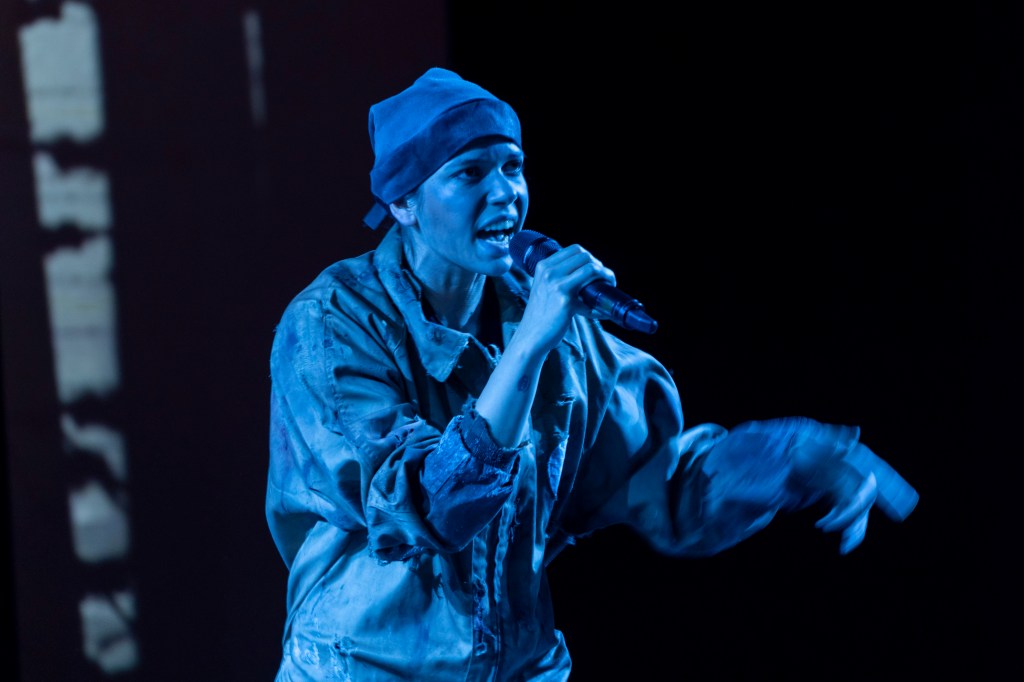
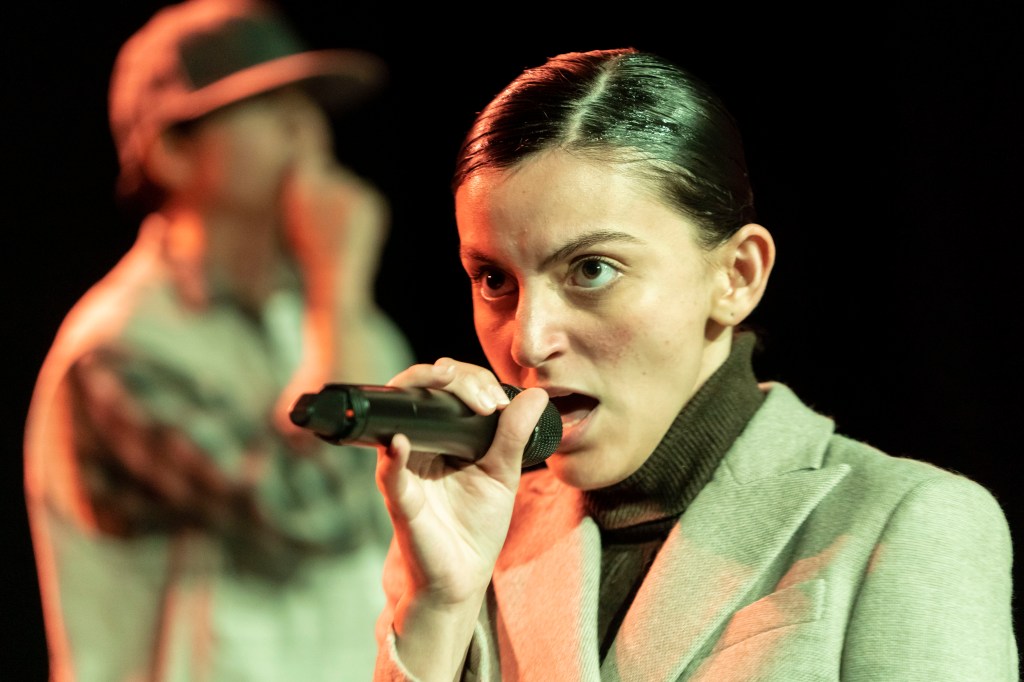
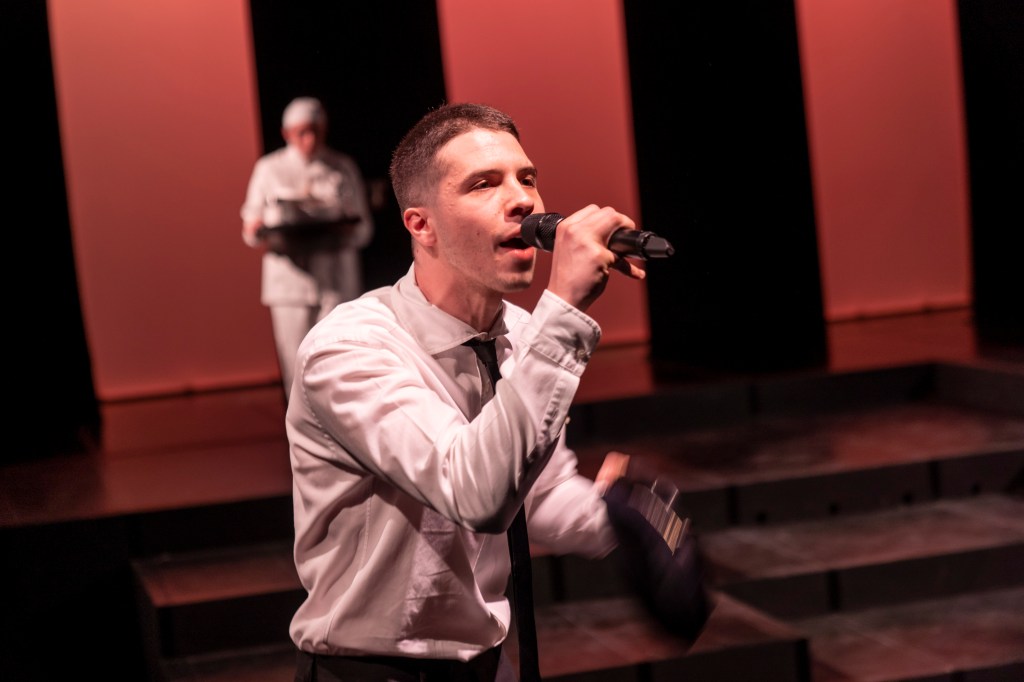
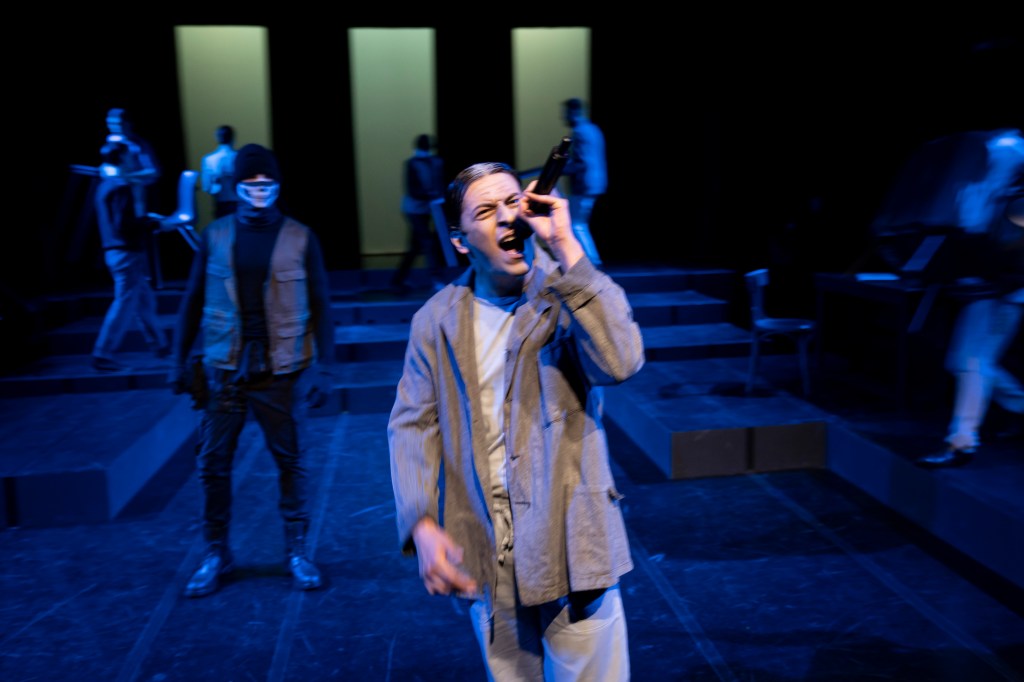
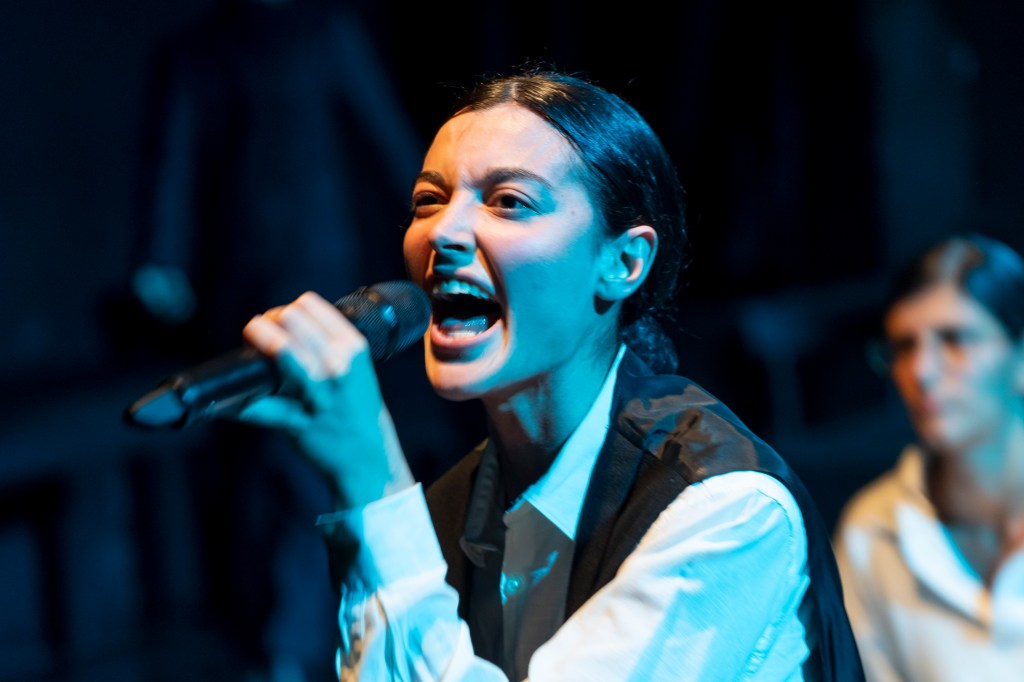
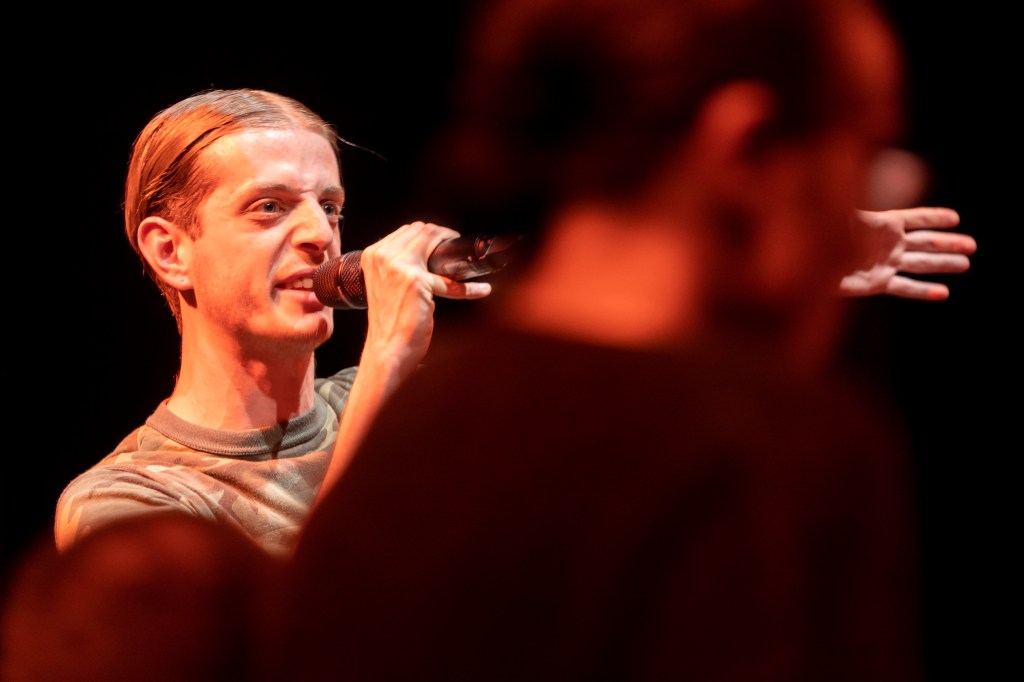
The other Brechtian touch was the remaking of the poetic prefaces to each scene as aggressive political hip-hop, rewritten by rapper Mirko ‘Kiave’ Felice and performed by seven of the actors (gallery below). This too was a first: despite having worked with live music in a wide range of genres and styles, I’ve never worked with hip-hop. The performance style Kiave encouraged in the rap intermezzi did a great deal to establish the starkly confrontational aesthetic of the show as a whole.
From strangeness to familiarity (reverse verfremmdungs?). As is noted elsewhere on this site, my maternal ancestors were Jewish refugees from Nazi Germany, who fled to the UK in the 1930s. My grandparents, Hilde and Karl, were the first of their families to venture forth, leaving their homes on different sides of Germany and meeting as young doctors in Edinburgh in 1934. They then extracted from Germany my grandmother’s parents, Siegfried and Karoline, I believe in 1936; my grandfather’s widowed father, Max, remained in Germany until 1938. I chose to tell Max’s story on day one of rehearsals for Terrore e Miseria, as my contribution to the familial research the students had all been asked to share. Max was also a doctor, and a decorated WW1 veteran: he’d won the Iron Cross for bravery in 1918, staying in a typhoid-stricken camp to tend to the sick when other medics aborted. Max evidently had staying power: he also stayed at his home in eastern Germany for the first five years of Nazi rule, perhaps thinking that his medal-winning military service would exempt him from whatever they had in store. In 1938 he was arrested for continuing to treat patients without a medical license, revoked by the Nazis that year. His cleaner bribed the police to release him on condition that he leave; he was allowed to flee, and joined the last ebbs of the flood of German Jews which managed to leave their homeland before it was too late. He spent the war crammed in a tiny house on the Fylde Coast with my grandparents, my mother and my grandmother’s parents, excepting six months in 1940 when he, Siegfried and Karl were all interned on the Isle of Man as ‘enemy aliens’. After the war Max left Britain to spend his last years with his daughter Hannah, who’d emigrated to the USA; and he now works his way through eternity in the Jewish cemetery of Westfield, NJ.
Like my great-grandfather Max, Brecht also fled Germany in 1938: his overt communist sympathies made him persona non grata with the Nazi regime, despite his not being Jewish. However his wife and close artistic collaborator, actress Helene Weigel, was Jewish. She had preceded him into exile in 1933, the same year my grandmother Hilde, newly graduated from medical school, left Germany.
The emotional centrepiece of Fear and Misery – at least for me – is the scene Brecht wrote for Weigel, The Jewish Wife. In it a Jewish woman, Judith Keith, who is married to an Aryan, makes phone calls to arrange matters for her husband Fritz before she flees to Amsterdam, and then conducts a series of imaginary farewell conversations with Fritz, who doesn’t know she’s leaving. He comes in at the end of the scene, realizes what’s happening, doesn’t really try to stop it, tells himself and her that it will only be for a few weeks; she refuses his offer to escort her to the station, and she leaves. It’s a perfect little domestic tragedy, played out in different ways in the real lives of tens or hundreds of thousands across Europe and worldwide in the mid-20th century and since, in these times of refugee crisis; it was also doubtless incredibly personal to Brecht, perhaps toying with a different way his own and Weigel’s stories might have gone.
I’d always been impressed with the theatrical virtuosity of the scene, but had surprisingly never really related it to my own family’s experiences. Not, that is, until rehearsing the scene with Serena DeCarli, the actor who played Judith. Serena is not Jewish, meaning my breaking a casting principle I’m increasingly passionate about; there were, however, no Jewish actors in the cohort, so I didn’t have a choice. (That in part my casting of Serena – who was brilliant – was related to a sense that she looked or acted credibly ‘Jewish’ is another complex truth.)
In working with Serena on the scene, I found myself speaking much of my fierce refugee paediatrician grandmother Hilde, whose betrayal by her native land led to a lifetime of visceral hatred for expressions of Germanness, combined with a dissonant love of German art and music. The Jewish Wife explores the moment in the Jewish-German psyche at which, as I described it to Serena, a long and passionate love affair between the two cultures is beginning a catastrophically ugly break-up; it was this tension which provided the torque of my grandmother’s anger with Germans, Germany, Germanity, all through her long life. And as a result of the same historical currents which cast her out from her home, Hilde also shared with Brecht’s heroine what Judith calls her “Jewish nationalism” in the scene – by which, of course, she means Zionism. That this word too is now stained by a fallacious association with fascism is a measure both of how far we have come in 75 years, and how we have also scarcely travelled at all.
In so many personal ways, then, this production was a first for me: first non-English production, first hip-hop production, first time in Italy, first time I’ve made a piece which explored or even really related to my own particular heritage. But it’s not enough justification for me in staining silence and nothingness, that a piece is personal for me. There must be a conscious outreach to the audience – which, as I encountered making work in New Zealand, is especially challenging and fascinating when you lack any knowledge at all of the subtle cultural nuances by which your particular audience receives narrative and participates in theatre.
So it was the actors, and the prodigiously talented team of student designers from the Accademia di Brera, with their shared Gen Z experience of contemporary Italy, who were the necessary vector of communication in pulling taut the thread connecting the past – frayed by history-lesson over-familiarity – and an Italian audience of 2023. The actors, in their final year of BA Acting studies, were an exceptionally talented company: one-note actors, not in the sense of having only one note, far from it, but in the sense that one only had to give them a note once for it to be acted upon or worked upon – a kind of actor every director relishes. They took some time to get used to the discipline, demands and parameters of creative responsibility, as I did to the absolute hegemony of the director in Italian rehearsal rooms. I was blessed once again with some wonderful collaborators from the technical staff at Paolo Grassi as well as Andrea Centonza, a fantastic young composer and sound designer who created the beats for Kiave’s intermezzi and underscored the whole production. I was also very grateful to be able to bring Bethan Clark to work on the show, whose expertise in the staging of both intimacy and violence allowed us to push the brutality of the piece, particularly the concentration camp sequence with its horrifying beating, to the necessary level. Protocols around boundaries and consent are only just beginning to be understood and accepted in Italy, so it was a privilege to be able to help furnish the next generation of actors with the language, skills and permission to establish and demand safe working practices.
Directorially, dramaturgically and linguistically, I could not have made this piece without the extraordinary work of Associate Director Silvia D’Anastasio (an alumna of Paolo Grassi and Central), who also translated for me in the rehearsal room, and Assistant Director Emma Bolcato. Their sensitivity and skills were not only critical in shaping the highly complex rehearsal process and the performances of the actors, they were also very much involved in the adaptation of the material and its dramaturgical construction. For Brecht specialists, the scenes we deployed were in the following order (with their position in Brecht’s dramaturgy bracketed):
- One Big Family (1)
- A Case of Betrayal (2)
- Workers’ Playtime (13)
- The Spy (10)
- The Chalk Cross (3)
- The Physicists (8)
- Judicial Process (6)
- Occupational Disease (7)
- Release (15)
- Job Creation (23)
- The Jewish Wife (9)
- Charity Begins at Home (16)
- The Sermon on the Mount (20)
- Peat-bog Soldiers (4)
- Servants of the People (5)
- The Box (14)
- Meat (Devised)
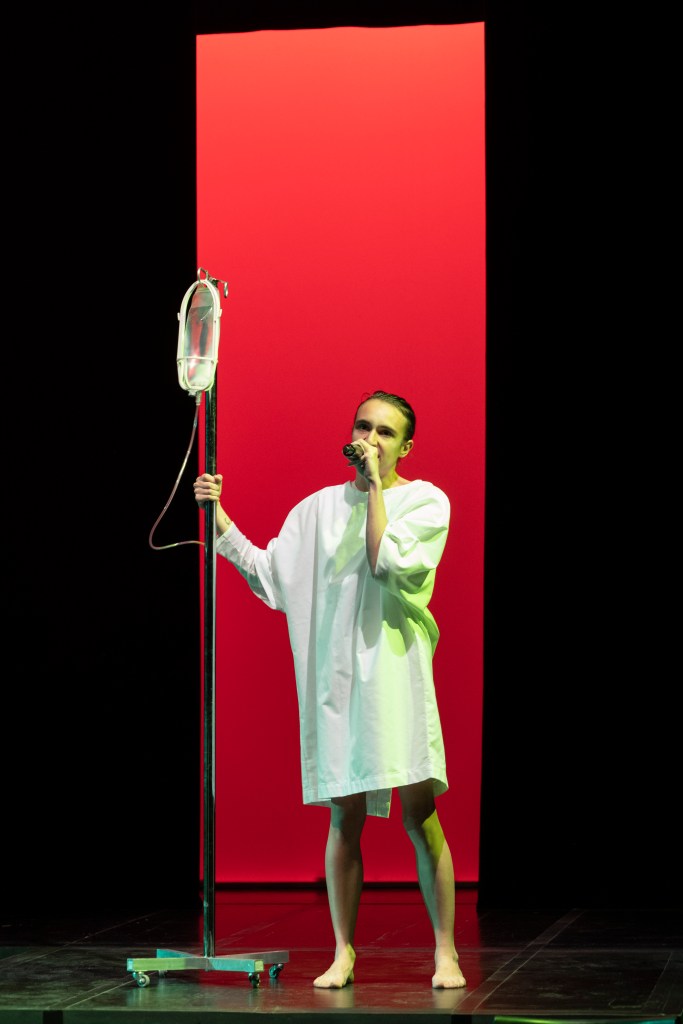
There were a few principles at work here. First of all, the scenes in the concentration camps, which come early in Brecht’s order, we kept until late in the production: contemporary audiences know about the camps, which are of course a necessary predicated context of any present-day performance of the play, whereas Brecht in 1938 needed to tell his audience about the camps. In our production the scenes served to remind the audience of where fascism leads, rather than to show them its context. The aesthetic we used was not exactly that of the Nazi camps, drawing also on contemporary artistic visions of such environments such as that in The Handmaid’s Tale; and we used a different (and deliberately illegible) approach to the ‘crime’-identifying badges of the camp inmates, all of which were circular and coloured differently from the Nazi camp badges. These were the only flashes of saturated colour in an otherwise monochromatic show, with the exception of the bright red dress and suitcase of the Jewish wife. Colour therefore represented dissent, freedom, liberalism (and thereby criminality); and other than the badges of the inmates, it was removed entirely from the stage environment when Judith fled. Those watching closely might have drawn a connection with the character of Dievenbach, brutally beaten in the concentration camp sequence, whose badge was also red.
This was another principle: to underline a different narrative drive for this production from Brecht’s conception, centering the dramaturgy around the human experience of totalitarianism rather than the escalating tactics of state terror. Partly this was achieved by ordering the scenes as a Dante-esque descent into ever-more horrifying circles of hell for the individual living under Nazism; and secondarily by creating connections between scenes by subtly allowing some characters to return. For instance Dievenbach, who moved from being picked out of a concentration camp chain-gang in Peat-bog Soldiers directly into being the subject of terrifying violence in Servants of the People (and who may or may not have been one and the same as the Neighbour in Job Creation, also played by Simona Bordasco). The other character to re-appear clearly was Lincke, played by Flavio Innocenti, who appeared first as a dissatisfied office worker in Workers’ Playtime, then, having apparently been sacked and beaten up as a result of his expression of dissent in that scene, in The Chalk Cross as the unemployed man fingered by the SA as a traitor; and then finally as the silent victim of even more extreme violence in Occupational Disease, the last scene of the first half. This was a deliberate and explicit effort to follow a character’s story through several scenes; but elsewhere other such narrative threads were suggested by doubling. Was the Young Woman played by Francesca Massari in Charity Begins at Home, dragged off to be raped by the SA at the end of the scene as punishment for her husband’s unguarded words, the same Young Woman she played in The Box, receiving from the SA the body of her husband in a zinc barrel? In other cases, the doubling aimed to stress the actors’ adaptability: we saw Cristian Zandonella rise from his deathbed in The Sermon on the Mount and cross the stage to become an inmate in Peat-bog Soldiers, and Lorenzo Ribaudo as the haunted Released Man of The Release removed a coat and a bandage to transform into the furious and paranoid Husband of Job Creation.
The other main dramaturgical principle was to do with the inclusion of contemporary digital technology. We introduced this in Workers’ Playtime, a scene which comes late in (and seems somewhat incidental to) Brecht’s construction; but which, with the radio announcer of the original transposed into a TV crew, was among the most immediate scenes thematically for our media-saturated contemporary reality, and which we therefore foregrounded as the first scene of substantial length in the show. The tendrils of authoritarian media then sneaked into the home; the paranoia-inducing chambermaid in the domestic environment of The Spy was replaced with an Alexa-like virtual assistant – who might indeed be listening in – while the teenage Klaus-Heinrich’s radicalization was apparently taking place partly online, in gaming forums. The ‘trick’ to catch political opponents employed by SA Man Theo in The Chalk Cross involved subtly recording dissent on his mobile phone; in The Physicists Y had received an incriminating email from Einstein; and before her departure into exile, rather than burning her address book, Judith Keith carefully removed her SIM card from the phone she’d spoken on throughout the scene, and determinedly cut it in half.
The idea of all of these adjustments – which in the context of the whole staging did not scream for attention – was to induce some level of tech-phobia in the audience. I wanted people to feel differently about their devices after the show, even if only momentarily. We’ve all wondered at times, haven’t we, how technology might be deployed against us by hostile actors. And what if that hostile actor is the state? As I remarked to the actors, we live at the first moment in history when an authoritarian government desirous of ridding society of dissent, might commit genocide against an entire group of people purely on the basis of their opinions. In such a scenario, giving political material a like online – or having done so at some point when it was not dangerous – might be signing your own death warrant. As a child who grew up steeped in awareness of the Holocaust, I remember once asking my grandmother how the Germans knew who was Jewish. “They just did”, she shrugged. Now, the tools of totalitarianism might extend not just to knowledge of our identity, but of our ideas. Terrifying times.
I made this production knowing that it would be a couple of years before I would direct again, as I prepared to move into a role I assumed at the end of 2023 as Dean of BADA. My gratitude goes to the faculty, staff and students of the Civica Scuola di Teatro Paolo Grassi and the Accademia di Brera, for creating and collaborating on this project with such energy, enthusiasm, professionalism, focus, creativity, and a genial air of va bene. Grazie mille.
 ben naylor